If You Blinked, You Missed an Entire Season of South Africa's Fashion History
By the time the industry finished processing one runway moment, another had already happened somewhere else.
And maybe that is the most accurate way to describe this season.
Somewhere between fashion weeks, independent showcases, experimental runways, train stations, cathedrals, viral TikTok moments, and creator-led documentation, South African fashion entered one of its most accelerated cultural periods in recent memory.
The industry is producing moments faster than the media can archive them. But what became increasingly clear moving from one show to another was that this shift was no longer only about clothing. Something deeper is happening. South African fashion is changing structurally, spatially, and culturally in real time.
The runway itself is evolving.

For years, South African fashion presentation largely existed inside practical environments: hotel ballrooms, convention centres, industrial spaces and temporary structures designed more for efficiency than emotional impact.
Functional rooms. Necessary rooms. But rarely rooms that magnified fashion itself
Now fashion is beginning to occupy space differently. And perhaps that has been the real story of the season.
At South Africa Fashion Week SS26, the return of the institution after its pause carried visible attempts at evolution. While the spatial language of the runway itself still felt familiar, there were subtle but important shifts in how audiences interacted with garments. One of the most striking changes came at the end of several runway presentations, where models paused long enough for audience members to physically approach the garments. People stood. They moved closer. They touched the fabric. They examined texture, construction, and silhouette at close range rather than from a distance.
It altered the relationship between audience and clothing entirely. Fashion stopped behaving like something untouchable and became something experiential. The runway became less about passive observation and more about physical engagement. There was also a noticeable expansion of ecosystem participation. Content creators, fashion personalities, and digital commentators were not simply invited to watch the shows - they were integrated into the environment itself.
Fashion week increasingly feels aware that modern runway culture no longer exists exclusively through editors and photographers alone. It now exists simultaneously through TikTok clips, creator interviews, backstage recordings, and real-time digital circulation. That awareness also explained why certain moments escaped the runway entirely and entered mainstream cultural conversation.
The opening showcase by Gert Johan Coetzee generated some of the strongest visual responses online, with the collection rapidly circulating through short-form video ecosystems that now shape public memory as much as the runway itself
But if SAFW represented institutional evolution, then Week Of Fashion South Africa represented structural expansion.

Formerly known as SA Menswear Week, the platform has evolved into something much broader: a fashion ecosystem extending beyond menswear into womenswear, demerging talent development, trade engagement, international partnerships and retail visibility. On paper, it might be one of the most ambitious structural pivots to happen within South African fashion.
The platforms expansion reflects a growing confidence within local fashion - the belief that South African design no longer needs to exist at the periphery of global fashion conversations. ''Local is lekker'' no longer reads as a slogan alone. It increasingly reads as infrastructure.
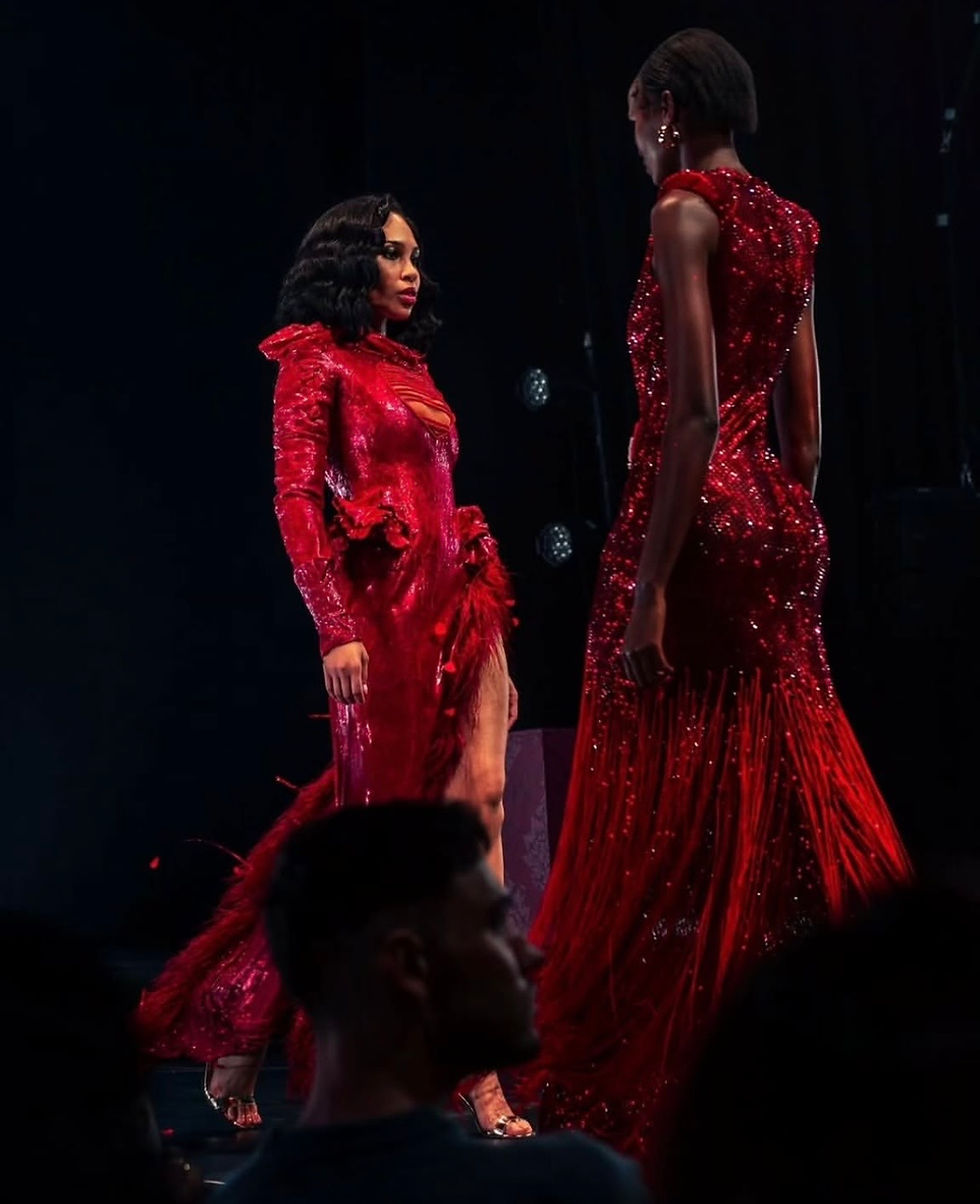
Yet ambition alone does not always guarantee emotionally unforgettable runway moments. This season revealed an interesting tension: the difference between structural growth and cultural impact. There were beautiful garments. Strong presentations. Familiar returning designers such as Haku, Idol Stitches, Imprint, Thabo Kopele continued contributing to the platforms identity. But emotionally, the season lacked the singular cultural eruption that occurred previously through Siyababa Ateliers now-viral red dress moment - a moment that escaped fashion entirely and entered mainstream South African consciousness
More than five million people viewed that moment online. That matters because it proved something important: in today's fashion ecosystem, virality, emotional theatre, and cultural resonance often travel further than runway schedules themselves. And while institutions were expanding structurally, independent showcases were quietly pushing runway language itself into more performative territory.
The BAM Collectives Romanticism became one of the clearest examples of this shift. the showcase rejected the traditional linearity of runway movement. Models did not simply walk, turn, and exit. They paused, held eye contact, and occupied space with intention. At times, it felt as though each model was temporarily granted authorship over the garment itself.

The lighting intensified this atmosphere dramatically, circular concentrated spotlights isolated models against darker surroundings transforming movement into theatre. The runway itself descended from an upper-level staircase before unfolding through the room, creating anticipation before garments fully emerged.
What The BAM Collective achieved was not simply presentation, but atmosphere. A reminder that runway culture is increasingly becoming immersive rather than merely functional.
But perhaps the most important shift happening within South African fashion right now is not performance. It is spatial imagination.
For decades, the visual language of monumental fashion spectacle has largely belonged to European capitals: Paris couture inside historic palaces, Milan presentations inside cathedrals, fashion framed through architecture carrying historical and cultural weight. South Africa's runway culture rarely occupied those kinds of spaces,
Until now.

When Onesimo Bam presented Progression V inside St George's Cathedral as part of Twyg Fashion Festival, something fundamentally shifted. For the first time in the cathedral's 160-year history, a fashion presentation of that scale occupied the sacred space, But the significance was never novelty. It was an architectural transformation. The cathedral did not function as a backdrop; it became a collaborator.
Vaulted ceilings altered proportions. Stone amplified stillness. Light-sharpened silhouette. The models did not appear to simply walk; they processed through space. White draped forms read almost liturgical against stained glass and ancient stone. Black sculptural garments carried a monastic sharpness, and the checkerboard aisle became visual choreography.
Location edited fashion

Most importantly, the show did not feel like an imitation of European spectacle. It felt like translation. The recognition of our own cinematic architectural potential.
The significance of Progression V continued long after the presentation itself. The production was later recognised by the A.I.D.A Awards in the avant-garde category, extending the conversation beyond South Africa and into broader continental creative discourse. Ahead of Progression V, co-creative director Tandekile Mkize reflected on how matriarchal memory and ritual shaped the cathedral performance. It's language that further reinforces how the presentation operated less as conventional runway and more as ceremonial spatial storytelling.
What made this spatial shift even more fascinating was how quickly it expanded beyond scared architecture and into public infrastructure.

Moments later, David Tlale staged a runway presentation inside Sandton Gautrain Station. Something previously almost unimaginable within South African runway culture suddenly became reality.
Unlike the cathedral's stillness, the Gautrain presentation carried movement at its core. Guests physically boarded trains to travel towards the show itself. The commute became part of the experience. Fashion individuals, creatives and industry figures moved together through public infrastructure toward a collective moment in South African fashion history.
The train ride itself became an anticipation. Fashion was no longer waiting statically inside a room. It unfolded through transition.

Even before the official showcase began, models dressed in designer garments had already been filmed occupying the station itself, disrupting ordinary commuter environments and transforming public space into fashion spectacle before the runway formally existed. It was disruptive in the best possible way.
Culturally, it signalled something larger: South African fashion is beginning to recognise that its cities, infrastructure, and architecture carry narrative power too. The train station became more than a venue. It became a metaphor. Movement. transition. Modernity. Urban rhythm
The runway is no longer confined.
Interestingly, this entire spatial conversation feels connected to the visual work of Thabo Mabotja, a photographer whose imagery has long reimagined everyday South African environments as potential runway spaces. Through directional markings and framing compositions, his photographs often read less like documentation and more like speculative runway blueprints
Before Fashion physically entered these unconventional environments, there were already creatives mentally redesigning them. That matters because what is happening in South African fashion right now is not accidental.
And while all of this acceleration was happening simultaneously, another transformation quietly emerged alongside it: a new generation of fashion media participation. At African Fashion Week, the runway itself may not have delivered the most emotionally overwhelming fashion experience of the season, but the platform represented something else entirely: growth, continental ambition, future building and ecosystem development.
The event's AFRO FUTURE theme explored African fashion's movement beyond visibility and toward influence - positioning African designers as globally relevant while remaining locally grounded in heritage and craftsmanship. Within that environment, I found myself participating differently.
Not only an attendee.
Not only as an observer
But as an interviewer
We conducted on-camera designer interviews under Trendsetters Only Magazine, speaking with Mc Alpine, Silk N' Cotton and Angalia Apparel.
The conversations explored inspiration, materials, sourcing, construction and identity. While the interviews themselves were imperfect, they represented something larger: participating in documenting South Africa fashion while it actively transforms.
Because perhaps the biggest issue revealed throughout this sprint of South African fashion is that the industry is evolving faster than its documentation systems. Too much fashion media still sounds promotional rather than interpretive. Too much language feels robotic rather than observational. Too many moments disappear before they are culturally archived.
Recently after posting reflections about the pace of South African fashion online, another creative responded by pointing toward something equally important: that fashion still occupies only a small percentage of the broader media landscape, and that much of its coverage often struggles to move beyond promotion into genuine observation, critique and cultural analysis. That observation stayed with me because it revealed something deeper beneath this current acceleration. The issue is not a lack of fashion activity. If anything, the industry is producing more moments than ever before. The challenge is whether the system documenting those moments are evolving at the same speed.
A younger generation of creators, commentators and digital journalists is beginning to build new forms of fashion documentation.
Maybe that is the real story underneath everything that has happened these past weeks. Not simply that South African fashion is growing, but that it is beginning to think differently.


Comments